Python makes it easy to explore data, call models, and prove an AI idea. Production software asks for more: stable interfaces, concurrency, security, reproducible environments, tests, queues, monitoring, and ownership. The transition fails when a successful notebook is mistaken for a deployable product.
That is why Python AI applications has moved from an interesting discussion to an operating decision. The useful question is not whether the trend is fashionable. It is whether the system can improve a customer journey, shorten a business process, protect margin, or give a team better information without creating a new layer of risk.
Why Python AI applications matters now
Python remains central to AI because its libraries and research ecosystem are broad. That strength can create dependency complexity and encourage application logic to grow inside scripts. A production approach preserves rapid experimentation while placing clear engineering boundaries around it.
The strongest teams begin with a measurable constraint rather than a technology shopping list. They identify where time, revenue, accuracy, or customer confidence is being lost. Then they decide which part of the workflow should be automated, which part should remain deterministic software, and where a person must keep final authority. This framing prevents an impressive demonstration from becoming an expensive product with no clear owner.
What a strong implementation looks like
Move model and data logic behind a versioned service contract. Use type hints and data validation, isolate dependencies, pin builds, and keep environment configuration outside code. Queue expensive jobs, stream progress where helpful, set resource limits, and expose health separately from model quality. Reproduce the complete environment in automated delivery.
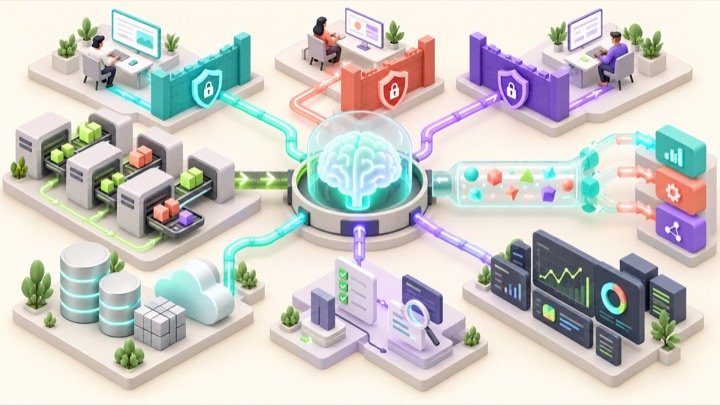
A production design should separate the user experience, business rules, data access, integrations, and monitoring. That separation makes the application easier to test and change. It also creates clear boundaries: sensitive data can be protected, external services can fail without breaking the entire journey, and a human can review actions that carry financial, legal, reputational, or operational consequences.
The decisions to make first
- Extract one deterministic callable pipeline from the exploratory notebook.
- Define validated request, response, error, and version contracts.
- Create unit, integration, load, and evaluation tests for representative workloads.
- Package and deploy through the same repeatable path in staging and production.
These decisions belong in the product brief, not only in a technical document. A business owner should be able to explain the expected outcome in one sentence, while the delivery team should be able to connect that outcome to events, logs, tests, and release criteria. Shared language is a practical control against scope drift.
Architecture principles that survive the hype cycle
Start with a dependable core. Keep customer identity, permissions, transactions, inventory, pricing, approvals, and audit history in systems with explicit rules. Add intelligent or probabilistic capabilities through narrow interfaces. If a model, search service, payment provider, or third-party API becomes unavailable, the application should fail clearly and preserve important work.
Use structured inputs and outputs wherever possible. Validate every response before it changes business data. Apply least-privilege access to users, service accounts, tools, databases, and automation. Store the evidence needed to understand what happened, but avoid logging secrets or unnecessary personal data. Build idempotency into background jobs and webhooks so retries cannot create duplicate orders, invoices, leads, or messages.
Performance deserves the same attention as features. Measure the slowest real journeys on mobile connections, not only fast local environments. Cache stable information, queue expensive operations, compress media, and set timeouts for every external dependency. A fast interface earns trust; a predictable recovery path keeps it.
Common failure modes
Production problems often arise around the model—in data loading, concurrency, memory, dependencies, and failure recovery.
- Unpinned native dependencies can produce irreproducible builds; use locks and immutable build artefacts.
- Long synchronous requests can exhaust workers; queue heavy work and publish progress safely.
- Model success can hide API or data regressions; monitor application reliability and output quality independently.
Treat these as design inputs. For each risk, assign an owner, a detection signal, a safe fallback, and a response plan. A useful risk register is short enough to review every release and specific enough to change a decision.
A practical 90-day delivery plan
Days 1–15: map the outcome
Document the current workflow from trigger to result. Record volumes, waiting time, rework, failure points, systems involved, and the people who approve exceptions. Establish a baseline before changing anything. Choose one journey that is valuable enough to matter and contained enough to learn from.
Days 16–35: prove the riskiest assumptions
Build a thin working slice using representative data. Test the hardest integration, the least certain user interaction, and the most consequential failure mode early. Review the prototype with the people who perform the work, not only the people who sponsor it. Their exceptions usually reveal the real product requirements.
Days 36–65: build the production path
Add authentication, permissions, validation, monitoring, accessibility, responsive behaviour, content states, retries, backups, and an audit trail. Write automated tests around business-critical rules. Keep releases small enough to diagnose. If the feature uses automation, provide a visible way to pause it and a clear route for human review.
Days 66–90: launch, observe and improve
Roll out to a controlled group. Compare behaviour with the original baseline, interview users, inspect failed journeys, and remove friction. Expand only after the product meets an agreed quality bar. The output of the first 90 days should be a reliable capability and a repeatable learning loop—not a frozen “final” version.
What to measure
- Build reproducibility and time required to recover or roll back.
- Request and job latency, throughput, memory, and timeout rate.
- Evaluation quality by model, data, code, and prompt version.
- Incidents caused by dependencies, capacity, data, or application logic.
Pair adoption metrics with quality and business metrics. More usage is not automatically better if errors, support load, refunds, or manual corrections also rise. Review leading indicators weekly and business outcomes monthly. Keep a written record of what changed so improvements can be attributed rather than guessed.
The WebIgnitors view
Python can support robust, large-scale applications when experimentation and serving are treated as different concerns. Keep the scientific loop flexible, but make the production boundary explicit, versioned, tested, and observable.
Good software compounds: each clean integration, reusable component, trustworthy data point, and observable workflow makes the next improvement less expensive. Approach Python AI applications as a business system with accountable owners and measurable outcomes, and the trend becomes a durable advantage rather than another experiment.